Outline
- What Actually Counts as a “Home Gym Essential”
- The Starter Kit: 4 Things Every Home Gym Needs First
- Level 2: When You’re Ready to Train Like You Mean It
- Cardio Equipment: What to Add (and What to Skip)
- The Stuff Nobody Tells You About: Flooring, Ventilation, Storage
- The Printable Home Gym Essentials Checklist
- What to Skip (For Now)
- FAQ
- Conclusion
Home Gym Essentials: The Complete Checklist (2026)
Walk into any fitness store and you’ll feel the pressure: rows of machines, walls of weights, and a salesperson who swears you need all of it. You don’t.
A great home gym isn’t built by buying everything. It’s built by buying the right things in the right order. This home gym essentials checklist is the order we’d give a friend who just moved into a new place and wants to start training at home without wasting money or floor space.
We’ve helped hundreds of beginners set up home gyms over the years, and the pattern is always the same. People either buy too much (a treadmill that becomes a clothes rack) or too little (nothing but a mat and good intentions). This checklist lands you in the sweet spot: enough gear to train every muscle group, little enough that your living room still looks like a living room.
What Actually Counts as a “Home Gym Essential”
An essential is something you will use in almost every workout for years. That’s the whole test. If a piece of equipment only serves one exercise, or only gets touched during a “new gear” honeymoon phase, it’s a luxury — not an essential.
By that standard, the real list is short:
- Something to train your legs with (dumbbells, kettlebell, or bands)
- Something to train your upper body push with (floor, bench, or bands)
- Something to train your upper body pull with (bands, pull-up bar, or dumbbell rows)
- Something for your core (a mat and your bodyweight)
- Something for cardio (your feet, a jump rope, or a machine if you must)
Everything else is optional. Keep that framework in mind as we go through the checklist — it’ll save you from 90% of impulse purchases.
The Starter Kit: 4 Things Every Home Gym Needs First
If your budget is tight or your space is small, these four items give you a complete training setup. You can run a serious full-body program with nothing else.
1. A quality exercise mat
Not the paper-thin yoga mat that slides across the floor. A proper training mat — 6mm or thicker, grippy on both sides, big enough for your body. It protects your joints on floor work, gives you a defined training zone (psychologically useful in small homes), and rolls up into a closet. Check current price on a high-density exercise mat; it’s one of the cheapest essentials you’ll ever buy.
2. Adjustable dumbbells
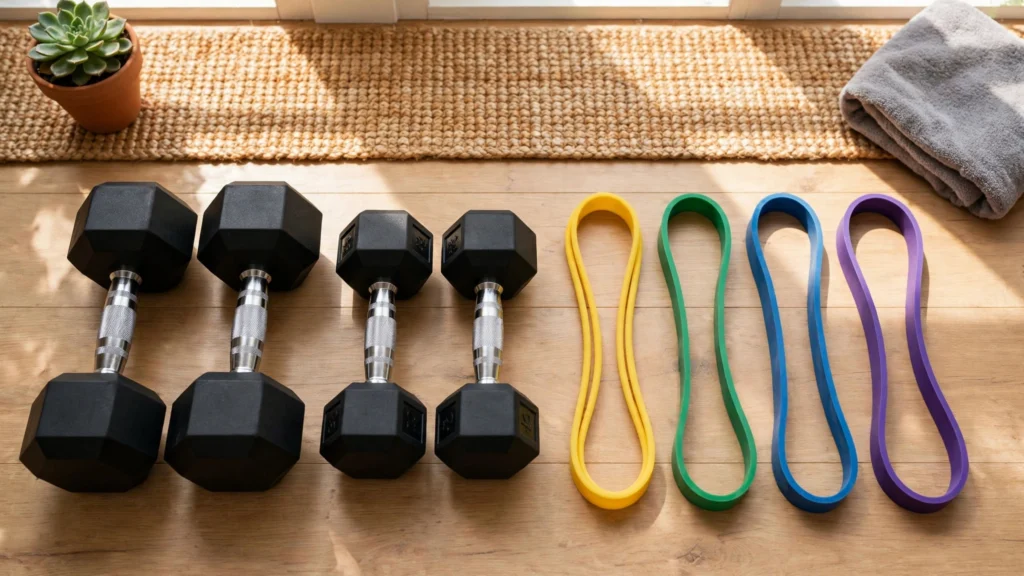
One pair replaces a whole rack. Dumbbells let you train goblet squats, Romanian deadlifts, floor presses, rows, lunges, curls, presses, and carries — that’s a full body in one tool. If space is truly microscopic, a resistance band set works as an alternative, but dumbbells train heavier and simpler for most people. See our dumbbell breakdown for the types worth buying.
3. Resistance bands (a full set, not one band)
Bands cover what dumbbells can’t: assisted pull-ups, face pulls, band pull-aparts for posture, warm-ups, and travel workouts. Buy a set of loop bands with multiple resistance levels plus one or two tube bands with handles. They weigh almost nothing and live in a drawer.
4. A jump rope
The cheapest cardio tool on earth. Ten minutes of jumping rope burns roughly as many calories as a moderate run, trains your calves and coordination, and fits in a jacket pocket. If you live in an apartment, get a cordless/beaded rope or do your skipping outdoors to keep the neighbors happy.
That’s it. Mat, dumbbells, bands, jump rope. With those four, you can follow our 4-week beginner plan end to end. For a second opinion on beginner programming, the free exercise library at Verywell Fit is a solid reference.
Level 2: When You’re Ready to Train Like You Mean It
You’ve been consistent for two or three months. The habit is real. Now it’s worth adding equipment that opens up new exercises — in this order:
Adjustable weight bench. A bench turns your floor press into a real bench press, your rows into chest-supported rows, and opens up step-ups, Bulgarian split squats, and hip thrusts. It doesn’t have to be fancy — flat-and-incline adjustability is enough for 95% of trainees. (Wondering if you even need one? Read our bench vs floor training breakdown first.)
Pull-up bar. Pull-ups and chin-ups are the best upper-body pulling exercise you can do at home, full stop. A doorway bar costs little, installs without screws in most frames, and folds away. Not strong enough for pull-ups yet? Bands looped over the bar give you assisted reps until you are.
A kettlebell. Swings, goblet squats, Turkish get-ups, snatches — the kettlebell fills the “powerful, athletic, slightly chaotic” gap in a home gym. One 16kg bell is a great start for most men; most women do well starting with 10–12kg.
A dip station or sturdy chairs. Dips are the upper-body push counterpart to pull-ups. A folding dip station is ideal, but two rock-solid dining chairs work in a pinch (test them for wobble first — seriously).
At this stage your gym handles strength training as well as most commercial gyms handle it for beginners. Everything past this point is specialization.
Cardio Equipment: What to Add (and What to Skip)
Here’s the honest take: most home cardio machines are expensive, bulky, and underused. Before you buy one, ask whether you’ll actually use it three times a week for a year. If the answer is “maybe,” spend the money on a better pair of dumbbells instead.
If you genuinely want a machine, rank them like this:
- A good jump rope — already in your starter kit. Most people never outgrow it.
- An adjustable bench + your bodyweight — circuits and EMOMs get your heart rate plenty high. See our budget cardio equipment picks.
- A compact bike or rower — only if you have a dedicated spot and a real love for that machine. Rowing is the better full-body pick; bikes are friendlier on joints.
What to skip: ab rollers with TV infomercial branding, vibrating platforms, and anything that promises to “tone” you while you watch Netflix. Your starter kit plus consistency beats all of it.
The Stuff Nobody Tells You About: Flooring, Ventilation, Storage
Equipment gets the glory, but these three boring things determine whether you actually train:
Flooring. Dropping a dumbbell on tile or hardwood is a fast way to lose a security deposit. Interlocking rubber floor tiles (the 20mm gym kind) absorb impact, deaden sound, and define your training zone. You only need enough to cover your workout footprint — 2×2 meters handles most people. Healthline has a good overview of home workout safety basics if you want to double-check your setup.
Ventilation and light. Train in the brightest, best-ventilated room you have, not the darkest corner. You’ll skip fewer workouts in a space that doesn’t feel like a storage unit. A cheap fan pointed at your face during summer sessions is worth more than most gadgets.
Storage that takes 60 seconds. If setting up your gym takes ten minutes, you’ll skip workouts. Everything should have a home: bands on a hook, dumbbells in their cradles, mat rolled in the corner. The best home gym is the one you can go from “couch” to “first set” in under two minutes.
The Printable Home Gym Essentials Checklist
Starter kit (buy first):
– [ ] High-density exercise mat (6mm+, non-slip)
– [ ] Adjustable dumbbell pair (or resistance band set as alternative)
– [ ] Loop + tube resistance band set
– [ ] Jump rope (weighted or speed, your choice)
– [ ] Interlocking rubber floor tiles for your training area
Level 2 (add after 2–3 consistent months):
– [ ] Adjustable weight bench (flat + incline)
– [ ] Doorway pull-up bar
– [ ] One kettlebell (start moderate, not heavy)
– [ ] Dip station or tested sturdy chairs
Nice to have (only if you’ll use them weekly):
– [ ] Foam roller for recovery
– [ ] Ab wheel
– [ ] Weight vest (only after bodyweight gets easy)
– [ ] Compact cardio machine you actually enjoy
Skip for now:
– [ ] Multi-station home gym machines (huge, pricey, hard to resell)
– [ ] Single-exercise gadgets
– [ ] Anything you haven’t wanted for at least a month
What to Skip (For Now)
A word on the biggest money traps. The all-in-one cable machine looks incredible in photos, but it costs a fortune, dominates a room, and most owners use three of its twelve stations. Plate-loaded leg machines are wonderful and completely unnecessary at home — Bulgarian split squats with dumbbells will humble your legs for years.
And the classic: the treadmill bought in January. If you love running, run outside — it’s free, the scenery changes, and the “machine” never becomes a drying rack. If you don’t love running, a treadmill won’t make you love it; it’ll just be an expensive reminder. Our cardio equipment guide covers the rare cases where a machine makes sense.
Quick note: this is general fitness guidance, not medical advice. If you have a heart condition, joint issues, or haven’t exercised in years, check with your doctor before starting a new training program.
FAQ
How much does a basic home gym cost?
It depends on what you buy and where you live, but a solid starter kit — mat, adjustable dumbbells, band set, jump rope, and floor tiles — costs far less than two years of most gym memberships. Buy the starter kit first; add Level 2 gear only after you’ve trained consistently for a few months.
How much space do I need for a home gym?
A 2×2 meter area (about 6.5 x 6.5 feet) is enough for a full dumbbell-and-bodyweight program. You need room to lie down with arms extended and to lunge in place. Most people overestimate the space they need and underestimate how much clutter gets in the way — clear the area first, then measure.
Should I buy everything at once or piece by piece?
Piece by piece, in the order of this checklist. Buying everything at once leads to gear you don’t understand yet and a dent in your budget before the habit exists. Earn each upgrade with two to three months of consistent training.
What’s the single best first purchase for a home gym?
Adjustable dumbbells, if your budget allows. One pair trains your entire body, lasts for years, and takes up almost no space. If money is tight, a full resistance band set is the best value alternative.
Can I build muscle with just the starter kit?
Yes — for a long time. Dumbbells plus progressive overload (more weight, more reps, better form over time) build real muscle for beginners and intermediates. You’ll eventually want a bench and pull-up bar to keep progressing, but the starter kit carries you through your first year or more.
Conclusion
The best home gym is not the biggest one. It’s the one you actually use — the gear within arm’s reach, the setup that takes a minute, the space that doesn’t annoy you.
Start with the starter kit. Train for a few months. Let your training tell you what to buy next: if your chest work stalls, that’s your bench calling; if your back needs more, that’s the pull-up bar. Buy in response to real training needs, not marketing.
Ready to build yours? Check current prices on the starter-kit items above, grab what fits your space and budget, and get moving — your first workout with your own gear is the best one you’ll ever do.