Outline
- The Small-Space Rules: Quiet, Compact, Fast Setup
- Best Home Gym Equipment for Small Spaces: Our 7 Top Picks
- How to Arrange a Workout Zone in 2 Square Meters
- Noise Control: Keeping the Peace With Neighbors
- Storage Tricks That Actually Work
- What NOT to Buy for a Small Space
- FAQ
- Conclusion
Best Home Gym Equipment for Small Spaces
A spare bedroom gym is a luxury most of us don’t have. The reality for most home trainees is a corner of the bedroom, a sliver of the living room, or a balcony that doubles as a laundry line.
Good news: small space is not a small workout. Some of the strongest people we know train in rooms barely bigger than a parking spot. The trick isn’t finding more room — it’s picking the best home gym equipment for small spaces, the kind that folds, stacks, hangs, or hides.
This guide covers exactly that: compact gear that delivers a real full-body workout, plus the layout and noise tricks that make apartment training sustainable.
The Small-Space Rules: Quiet, Compact, Fast Setup
Before buying anything, judge every purchase against three rules:
- Quiet. Thin walls and downstairs neighbors mean no dropping weights, no slamming, no machines that rattle. Rubber-coated, controlled, and deliberate wins.
- Compact when stored. Measure your storage spot — under the bed, behind the door, inside the closet — before you buy. If it doesn’t fit there, it doesn’t fit your life.
- Fast setup. In a small home, your gym shares space with your life. If setup takes more than two minutes, you’ll start skipping sessions. Fold-out, roll-out, hook-on: that’s the language of small-space equipment.
One more rule: every piece should earn its floor space weekly. In a big garage gym, a dusty leg press is a decoration. In a studio, it’s a crisis.
Best Home Gym Equipment for Small Spaces: Our 7 Top Picks
1. Adjustable dumbbells
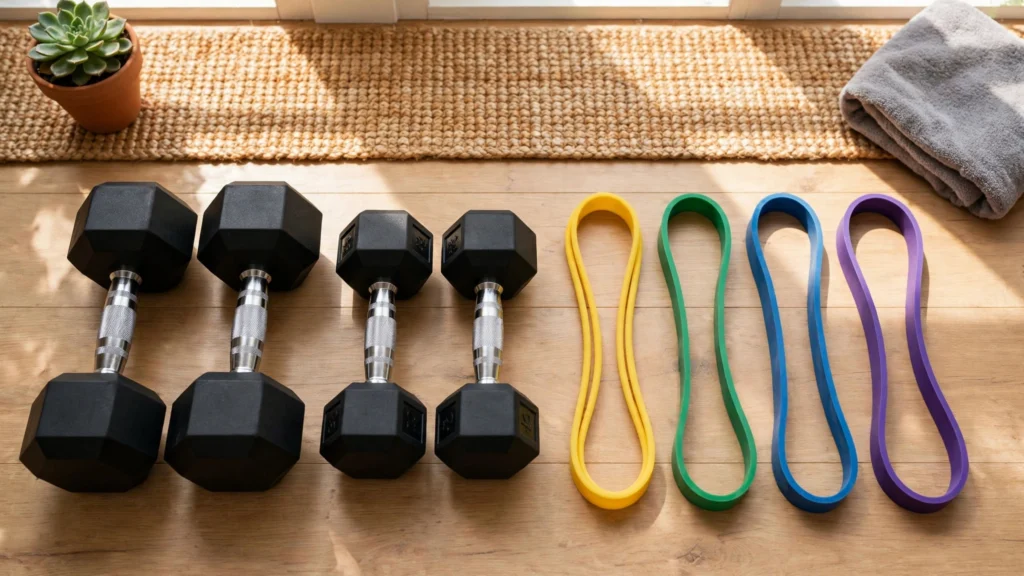
The single best space-saving strength tool ever made. One pair replaces an entire dumbbell rack and lives in a footprint smaller than a doormat. For apartment training, dial or twist adjustables are ideal — fast weight changes, no loose plates clanking around. See our full dumbbell comparison for which types suit beginners.
2. Resistance band set
Bands are the ultimate small-space equipment: a full set fits in a shoebox and trains everything from warm-ups to heavy rows to assisted pull-ups. Loop bands plus a door anchor turn any door into a cable machine. If you can only buy one thing for a truly tiny space, make it this — our bands vs dumbbells guide breaks down the trade-offs honestly.
3. Foldable adjustable bench
A bench opens up presses, rows, step-ups, and hip thrusts — but a full-size bench eats a room. Foldable flat benches collapse to a few inches thick and slide behind a door or under a bed. Look for one rated well above your body weight, with a secure locking mechanism you trust. Still on the fence? Our bench vs floor article settles it.
4. Doorway pull-up bar
No screws, no drilling, no landlord drama. A leverage-style doorway bar installs in seconds and removes just as fast. It’s the best upper-body pulling tool for home, and you can hang bands or gymnastic rings from it for rows and assisted work. Check your doorframe width and trim strength first — most standard interior frames work fine.
5. Kettlebell (just one)
One kettlebell does the work of a cardio machine and a weight set combined: swings, goblet squats, presses, carries, Turkish get-ups. It needs about one square meter of floor and stores in a corner. Start with a moderate weight you can swing safely — form first, heavy later.
6. Jump rope
Cardio that fits in a drawer. Ten minutes of skipping torches calories, builds calves, and sharpens coordination. Apartment dwellers: jump on your rubber mat, or take the rope to the courtyard — your downstairs neighbor will thank you. Our jump rope guide covers which types suit beginners.
7. A good mat + interlocking floor tiles
This is infrastructure, not glamour. A thick mat plus two to four interlocking rubber tiles defines your training zone, protects the floor, and cuts noise dramatically. When the workout’s done, stack the tiles in the corner or slide them under the bed.
How to Arrange a Workout Zone in 2 Square Meters
You don’t need a “gym room.” You need a gym zone — a defined patch of floor that means “training happens here.” Here’s the layout that works in the smallest homes:
- Pick one wall. Everything stores against it: bench folded, dumbbells tucked under, bands on a hook, mat rolled in the corner.
- Face away from furniture. You need roughly 2m x 2m of clear floor. Move one chair or coffee table — that’s usually enough.
- Use vertical space. Wall hooks for bands and ropes, an over-door organizer for small gear, a high shelf for the foam roller. Floors are precious; walls are free.
- Keep a “launch pad.” A small basket or box with your bands, rope, and workout log. Grab it, train, put it back. Two-minute setup, every time.
We know a coach who trains clients’ full programs in a 1.8m x 2.4m balcony. The zone matters more than the square footage. Verywell Fit has more small-space workout ideas if you need extra inspiration.
Noise Control: Keeping the Peace With Neighbors
Nothing kills a home gym habit faster than an angry neighbor banging on the ceiling. Apartment-friendly training is a skill:
- Never drop weights. Lower every rep under control. This is good training anyway — the eccentric (lowering) phase builds plenty of muscle.
- Rubber under everything. Floor tiles under your training zone, a rubber mat under dumbbells. Sound drops dramatically.
- Swap jumping for low-impact. Burpees, jump squats, and box jumps are loud. Replace them with step-back lunges, slow mountain climbers, and kettlebell swings (swings are surprisingly quiet).
- Train at neighbor-friendly hours. Heavy or rhythmic sessions before 8am or after 10pm are asking for trouble. Midday and evening are your friends.
- Talk to your neighbors. A quick “hey, I work out at home around 6pm, let me know if it’s ever too loud” prevents 90% of conflicts. People tolerate a lot from someone who’s considerate.
Storage Tricks That Actually Work
- Under the bed: flat-folding benches, stacked floor tiles, rolled mats.
- Behind the door: hooks for bands, ropes, and lifting straps.
- Inside the closet: adjustable dumbbells on the floor, kettlebell beside them.
- On the wall: a simple pegboard or a few heavy-duty hooks turns dead wall space into a gear station.
- The “everything box”: one lidded box for small items (grips, timers, bands). If it doesn’t fit in the box, something has to go.
The golden rule: if a piece of equipment doesn’t have a storage home, you’ll trip over it, resent it, and eventually stop using it.
What NOT to Buy for a Small Space
Be honest with yourself here:
- Treadmills and ellipticals. They dominate a room, they’re loud, and they become expensive coat racks. Run outside or skip rope instead.
- Full power racks. Wonderful gear, wrong context. A doorway pull-up bar plus dumbbells covers 90% of what a rack does for a beginner.
- Multi-station home gyms. A dozen exercises in the footprint of a sofa — and you’ll use three of them.
- Olympic barbells and bumper plates. Unless you have a garage or a very understanding ground-floor setup, the space, noise, and floor-loading math doesn’t work.
- Anything “as seen on TV.” If it promises results in “just 4 minutes a day” and folds into a suitcase, it’s a suitcase, not a gym.
For the full reasoning and what to buy instead, our home gym essentials checklist ranks every purchase by priority. For independent equipment reviews, Healthline’s fitness section is a decent cross-check.
FAQ
Can you really get fit working out in a small apartment?
Absolutely. Muscle responds to progressive resistance, not square footage. Dumbbells, bands, a pull-up bar, and bodyweight cover every major movement pattern. Thousands of people have built impressive physiques in studio apartments — the constraint is consistency, never space.
What’s the best equipment for a bedroom home gym?
Adjustable dumbbells, a resistance band set, a foldable bench, and a mat. That combination trains your whole body, stores in a closet, and stays quiet enough for shared walls. Add a doorway pull-up bar when you’re ready for serious back training.
How do I work out in an apartment without bothering neighbors?
Train on rubber flooring, never drop weights, swap jumping moves for low-impact alternatives, and keep intense sessions to daytime and early evening hours. A quick heads-up conversation with neighbors prevents most complaints before they start.
Is a foldable bench sturdy enough for real training?
A good one is. Look for a bench rated well above your body weight plus the weights you’ll lift, with a locking mechanism that clicks solidly into place. Cheap no-name folding benches wobble — spend a little more here, because a wobbly bench is a bench you won’t trust under load.
Should I just get a gym membership instead of cramming gear into a small space?
It depends on your personality, not your floor plan. If you’ll actually go to the gym three times a week, a membership is great value. If the commute, crowds, or schedule kill your consistency, a compact home setup you’ll use beats a membership you won’t. Our cost breakdown compares both honestly.
Conclusion
Small space is an advantage in disguise. It forces you to buy only what works, learn every exercise deeply, and keep your setup ruthlessly simple — which is exactly how the best home gyms are built anyway.
Start with dumbbells, bands, a mat, and a rope. Add the foldable bench and pull-up bar once the habit sticks. Check current prices on the compact picks above, measure your storage spots before you order, and turn that corner of your room into the most productive two square meters in your home.