
Outline
- Why Dumbbells Are Perfect for Home Leg Day
- What Weight Should You Use?
- The 10 Exercises
- The Full Workout: Two Routines
- Form Mistakes to Avoid
- How to Progress Week to Week
- FAQ
- Conclusion
Dumbbell Leg Workout at Home: 10 Exercises for Bigger Legs
Bodyweight leg training will take you far — but there’s a moment every home trainee hits when 30 air squats feel like a warm-up and your legs stop changing. That’s not failure; that’s your signal. A dumbbell leg workout at home is the simplest, cheapest way to break through that ceiling without a gym membership, a squat rack, or a room full of machines.
One pair of dumbbells (adjustable is ideal) opens up real progressive overload for your quads, hamstrings, glutes, and calves. Below are the 10 exercises that matter most, plus two complete routines you can start this week.
Why Dumbbells Are Perfect for Home Leg Day
Barbells are great, but they need a rack, a bench, and floor space you probably don’t have. Dumbbells ask for almost nothing: a corner of your room and enough ceiling clearance to stand up straight.
They also train each side independently. Every rep forces your left and right legs to do equal work, which quietly fixes the strength imbalances that barbells let you hide. And because you can drop them safely, dumbbells let you train close to failure at home without a spotter — which is where growth happens.
If you haven’t bought a set yet, read our comparison of the best adjustable dumbbells for home workouts before spending money. A good adjustable pair replaces a whole rack of fixed dumbbells.
What Weight Should You Use?
The honest answer: it depends on the exercise and your level. As a starting guide:
- Beginners: 5–10 kg (10–20 lb) per dumbbell for squats and deadlifts; lighter (3–5 kg) for single-leg work.
- Intermediate: 10–17.5 kg per dumbbell for main lifts.
- The test: your last 2 reps of every set should feel genuinely hard while your form stays clean. If you could do 5 more reps easily, go heavier. If your form breaks, go lighter.
One adjustable pair covering roughly 2.5–24 kg per dumbbell handles almost every exercise below for most people. Check current prices from reputable sellers — adjustable sets vary wildly in cost, and you don’t need the most expensive one.
The 10 Exercises
Warm up first with our leg day warm-up routine — six minutes that protects your knees and hips.
1. Goblet Squat
Hold one dumbbell vertically at your chest, elbows tucked. Squat deep, keeping the weight close to your body — it acts as a counterbalance that actually improves your squat form. 3–4 sets of 10–15 reps. The single best dumbbell leg exercise for beginners.
2. Dumbbell Romanian Deadlift
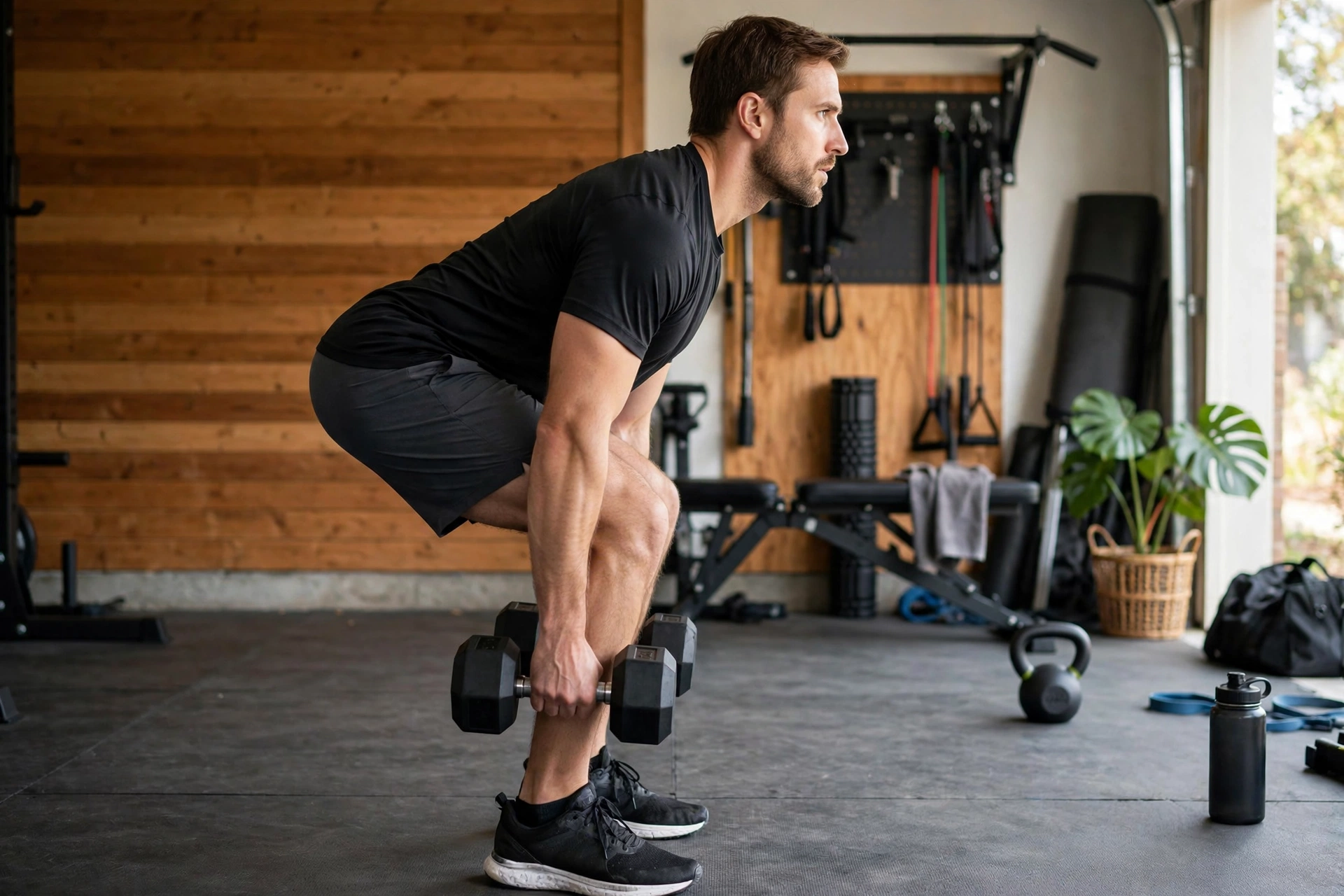
Hold a dumbbell in each hand in front of your thighs. Hinge at the hips, pushing your butt back while the weights slide down your legs to about mid-shin. Feel the deep stretch in your hamstrings, then drive your hips forward to stand. Slight knee bend, flat back, always. 3–4 sets of 10–12 reps. This is your main hamstring builder — our hamstring workout at home has more.
3. Dumbbell Reverse Lunge
Dumbbells at your sides, step one foot back, lower until your back knee nearly touches the floor, drive up through the front heel. 3 sets of 10 reps per leg. Reverse lunges are easier on the knees than forward lunges and you can load them heavy.
4. Dumbbell Step-Up
Hold dumbbells at your sides, step onto a sturdy chair or bench, drive up through the heel, and lower with control. 3 sets of 10 reps per leg. Use a surface at knee height — too high and your knee takes over; too low and it’s just a big step.
5. Bulgarian Split Squat
Back foot resting on a chair, dumbbells at your sides, lower straight down on the front leg. 3 sets of 8–10 reps per leg. Start light — balance plus load is humbling. This one exercise can carry your entire quad development at home.
6. Dumbbell Sumo Squat
Wide stance, toes pointed out 45 degrees, one heavy dumbbell hanging between your legs. Squat down keeping your chest up and knees tracking over your toes. 3 sets of 12–15 reps. Hits the inner thighs and glutes from an angle regular squats miss.
7. Single-Leg Romanian Deadlift
One dumbbell in the opposite hand of your standing leg. Hinge forward on one leg, extending the free leg behind you, then return. 3 sets of 8 reps per leg. Balance, hamstrings, and glutes in one move. Touch a wall for balance at first — no shame in it. More single-leg progressions live in our single-leg exercises guide.
8. Dumbbell Glute Bridge / Hip Thrust
Upper back on a couch or low bench, dumbbell resting on your hips, feet flat on the floor. Drive your hips up, squeeze hard for 2 seconds. 3–4 sets of 12–15 reps. The heaviest glute exercise you can do at home.
9. Dumbbell Calf Raise
Hold dumbbells at your sides, stand on a step or thick book with heels hanging off, rise high onto your toes, pause, lower below step level for a full stretch. 4 sets of 15–20 reps. Calves need volume and full range — half-reps build half-calves.
10. Dumbbell Wall Sit (Loaded)
Back against the wall, thighs parallel, a dumbbell resting on each thigh. Hold 30–45 seconds. 3 rounds. A brutal finisher that fries your quads when they think the workout is over.
The Full Workout: Two Routines
Routine A — Quad & Glute Focus (45–50 min)
- Goblet Squat — 4×12
- Bulgarian Split Squat — 3×10 per leg
- Dumbbell Step-Up — 3×10 per leg
- Dumbbell Hip Thrust — 3×15
- Dumbbell Wall Sit — 3×40 sec
Routine B — Hamstring & Glute Focus (45–50 min)
- Dumbbell Romanian Deadlift — 4×10
- Dumbbell Reverse Lunge — 3×10 per leg
- Single-Leg Romanian Deadlift — 3×8 per leg
- Dumbbell Sumo Squat — 3×12
- Dumbbell Calf Raise — 4×18
Alternate A and B across the week (e.g., Monday and Thursday). Rest 60–90 seconds between sets, 2 minutes between exercises.
New to structured training? Our 4-week beginner home workout plan shows how leg days fit into a full week.
Form Mistakes to Avoid
Rounding your back on deadlifts. The moment your lower back rounds, the load shifts to your spine. Keep your chest proud, lats tight, and stop the rep when you feel your back wanting to round — even if the dumbbells haven’t reached mid-shin.
Knees diving inward. On every squat and lunge variation, your knees should track over your toes. If they collapse, drop the weight and fix the pattern first. Your joints will outlast your ego.
Half reps on calf raises. Bouncing through partial reps is the reason so many people have stubborn calves. Full stretch at the bottom, full squeeze at the top, every rep.
Holding your breath. Exhale on the effort (standing up), inhale on the lowering. Holding your breath through a whole set spikes blood pressure unnecessarily.
Copying someone else’s stance. Foot width, toe angle, and step length are personal. Use the guidelines above, then adjust until the target muscle does the work and your joints feel fine.
How to Progress Week to Week
Dumbbells make progression beautifully simple — this is progressive overload in its purest form:
- Week 1–2: Learn the movements. Pick weights that leave 3 reps in reserve.
- Week 3–4: Add one rep per set, or add a fourth set to main lifts.
- Week 5+: Increase dumbbell weight by the smallest jump available when you can complete all sets with 1–2 reps to spare.
If your adjustable dumbbells jump 2.5 kg at a time and that’s too much for single-leg work, add reps first and weight second. Progress is progress.
For general form references beyond this guide, Verywell Fit and Healthline both maintain solid exercise libraries worth bookmarking.
Quick note: this is general fitness information, not medical advice. If you have joint pain or a medical condition, get professional guidance before loading up.
FAQ
How heavy should my dumbbells be for leg day?
Most people need 10–20 kg per dumbbell for main lifts like goblet squats and Romanian deadlifts, and 5–10 kg for single-leg work. An adjustable set covering 2.5–24 kg per dumbbell serves the vast majority of home trainees.
Can I build big legs with just dumbbells?
Yes. Dumbbells allow genuine progressive overload — the actual driver of muscle growth — for every major leg muscle. You’ll eventually want heavier loads for deadlift patterns, but that point is years away for most people.
Dumbbells vs barbells for legs — which is better?
Barbells allow heavier absolute loads, which matters for advanced lifters. Dumbbells win on convenience, safety without a spotter, and fixing left-right imbalances. For home training, dumbbells are the practical champion.
How often should I do this workout?
Twice per week, alternating Routines A and B, with at least 48 hours between sessions. Add a third day only when recovery (sleep, soreness, energy) clearly supports it.
My lower back hurts after Romanian deadlifts — am I doing it wrong?
Probably. Back pain during RDLs almost always means rounding or going too low. Shorten the range, brace your core like someone’s about to poke your stomach, and keep the dumbbells close to your legs. If pain persists, stop and see a professional.
Conclusion
Ten exercises, one pair of dumbbells, zero excuses. This dumbbell leg workout at home gives you everything a leg press and squat rack would — quad size, hamstring strength, glute power — in the corner of your room. Pick Routine A or B, run it twice a week for two months, and add weight when the reps get comfortable.
Ready to equip your home leg day properly? Compare options in our best adjustable dumbbells guide — check current prices from reputable sellers and buy the set that fits your space and budget, not the most expensive one. Your legs are about to get a lot stronger.