
Outline
- Why You Need More Than One Squat
- Level 1: The Foundations (Start Here)
- Level 2: Building Real Strength
- Level 3: Advanced (Earn These)
- Level 4: Brutal (The Final Bosses)
- How to Program Squat Variations
- FAQ
- Conclusion
15 Squat Variations to Do at Home (From Easy to Brutal)
The squat is the most important lower-body movement you can do — but doing the same air squat for six months is a recipe for boredom and stalled legs. These squat variations at home are ranked from genuinely easy to genuinely brutal, so you always have a next step waiting. Find your level, master it, and move up.
One rule before we start: never sacrifice depth and control for a harder variation. A deep, slow air squat builds more leg than a sloppy pistol squat ever will.
Why You Need More Than One Squat
Different squat variations shift the emphasis across your quads, glutes, inner thighs, and core. They also let you keep progressing without equipment — when regular squats get easy, you don’t need heavier weights; you need a harder variation. That’s progressive overload without spending a cent.
Variety also keeps your joints happy. Rotating variations changes the stress patterns on your knees and hips, which is one reason people who vary their squats tend to train pain-free longer.
Level 1: The Foundations (Start Here)
1. Box Squat
Stand in front of a sturdy chair. Squat back until your butt lightly touches the seat, then stand. The chair teaches you to sit back instead of diving your knees forward. 3 sets of 12–15. If regular squats feel awkward, start here for two weeks — no shame in it. Our bodyweight leg workout for beginners uses these as its foundation.
2. Air Squat
The classic. Feet shoulder-width, toes slightly out, hips back, chest up, as deep as your mobility allows. 3 sets of 15–20. Master the 3-second lowering phase before moving on — tempo is free difficulty.
3. Sumo Squat
Wide stance, toes out 45 degrees. This shifts work to your inner thighs and glutes. 3 sets of 15. Great for people whose knees complain during narrow squats.
4. Wall Squat (Assisted)
Face a wall with your toes a few inches away and squat. The wall forces an upright torso and teaches perfect balance. 3 sets of 10. Surprisingly humbling.
Level 2: Building Real Strength
5. Goblet Squat
Hold a dumbbell or any heavy household object at your chest and squat deep. The front load counterbalances you and lets most people squat deeper instantly. 3–4 sets of 10–15. The king beginner-to-intermediate squat. See it in our dumbbell leg workout at home.
6. Pause Squat
Squat down and freeze for 3 full seconds at the bottom before standing. No bounce, no momentum. 3 sets of 8–10. This kills the stretch reflex that usually helps you out of the hole — your muscles do 100% of the work.
7. 1.5-Rep Squat
Squat all the way down, come halfway up, go back down, then stand fully. That’s one rep. 3 sets of 8. The extra half-rep keeps constant tension on your quads. You’ll feel these for days.
8. Close-Stance Squat
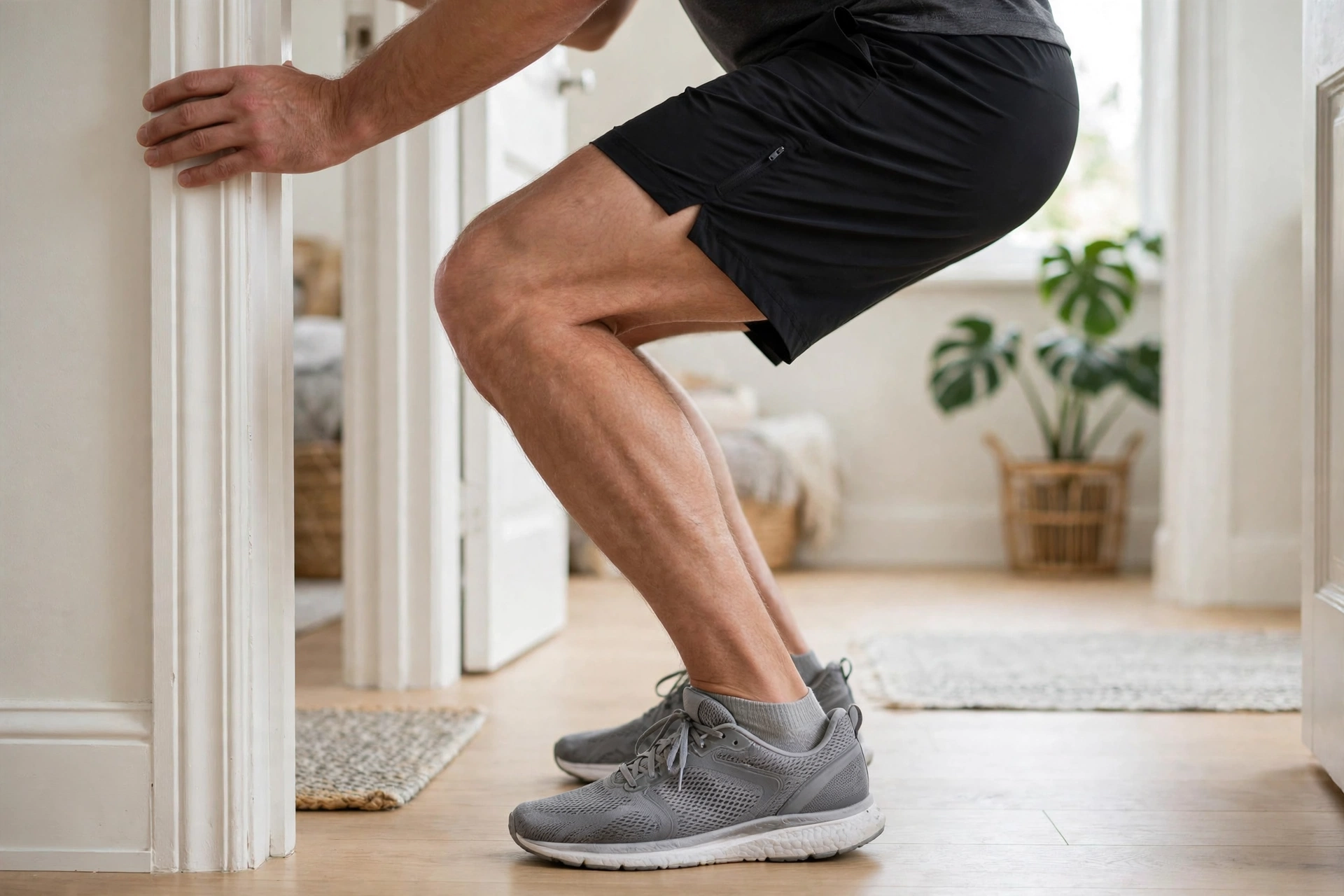
Feet together, squat deep. This hammers the outer quads (the vastus lateralis) and demands serious ankle mobility. 3 sets of 12. Hold a doorframe for balance while learning.
9. Lateral Squat (Cossack Squat)
Wide stance, shift your weight to one side, squatting deep on that leg while the other stays straight. Alternate sides. 3 sets of 8 per side. Builds lateral strength and hip mobility that regular squats never touch.
Level 3: Advanced (Earn These)
10. Bulgarian Split Squat
Back foot on a chair, all the work on the front leg. 3 sets of 8–10 per leg. Technically a lunge pattern, but it belongs here because it’s the single best quad builder you can do at home. Expect one leg to be weaker — train the weak side first.
11. Shrimp Squat
Stand on one leg, hold your other foot behind you, and squat down until your back knee touches the floor. 3 sets of 6–8 per leg. A gentler gateway to pistol squats with the same single-leg benefits.
12. Sissy Squat
Hold a doorframe or sturdy furniture, lean your torso back as your knees travel forward, and lower until your thighs are parallel. 3 sets of 8–10. Despite the name, this is one of the most intense quad isolations that exists — your quads do nearly all the work.
Level 4: Brutal (The Final Bosses)
13. Pistol Squat
One leg, full depth, other leg extended forward, no support. 3 sets of 5 per leg. The bodyweight squat’s final exam — it demands strength, balance, ankle mobility, and patience. Build up with shrimp squats and assisted pistols (holding a doorframe) for weeks before attempting free ones.
14. Jump Squat
Squat and explode upward, landing softly back into the next rep. 4 sets of 10. Builds the explosive power that slow squats don’t. Land toe-to-heel with soft knees — loud landings mean your joints are absorbing what your muscles should handle.
15. Pistol Squat to Box (Depth Progression)
Pistol squat down to a chair, then progress to lower and lower surfaces. It’s the smart way to earn the full pistol without face-planting into your coffee table.
How to Program Squat Variations
Don’t do all 15 in one workout. Pick 2–3 variations per leg session:
- Beginners: 2 Level-1 moves (e.g., box squat + sumo squat), 3 sets each, twice a week.
- Intermediate: 1 Level-2 + 1 Level-3 (e.g., goblet squat + Bulgarian split squat), 3–4 sets each.
- Advanced: 1 Level-3 + 1 Level-4 (e.g., shrimp squat + jump squats), plus a finisher like wall sits.
Every 3–4 weeks, swap one variation for the next level up. That’s your progression plan — simple, free, and effective. Warm up with the leg day warm-up routine before any of these, especially the single-leg work.
For general squat form references, Verywell Fit has a solid exercise library, and Healthline covers the basics well.
Quick note: this is general fitness information, not medical advice. Knee pain that persists beyond normal muscle soreness deserves professional attention.
How to Test Your Squat Level
Not sure where you belong on the ladder? Try this quick self-test. Do 15 slow bodyweight squats with a 3-second lowering phase. If your form breaks down or you can’t reach depth, you’re Level 1 — start with box squats and own them for two weeks. If 15 feels comfortable, try 10 pause squats next. Clean reps mean you’re ready for Level 2. Can you do 8 Bulgarian split squats per leg with solid balance? Welcome to Level 3. And if you can do 5 unassisted pistol squats per leg — honestly, you don’t need this article, but we’re glad you’re here anyway.
Retest yourself every month. Moving up a level is one of the most satisfying moments in home training, and it costs absolutely nothing. Keep a note on your phone with your current level and the date you earned it — small wins, tracked, become big progress.
FAQ
How many squat variations should I do per workout?
Two to three. More than that and your later sets suffer — quality beats quantity. Pick variations that target slightly different angles (e.g., one bilateral, one single-leg).
Can squat variations replace weighted squats?
For a long time, yes. Single-leg and tempo variations can challenge your legs for many months. Eventually, adding external load (dumbbells, a weighted backpack) becomes the most efficient path — but most home trainees never fully exhaust bodyweight progressions.
Why can’t I squat deep?
Usually ankle or hip mobility. Try elevating your heels on a thin book — if depth improves instantly, ankles are the limiter. Daily deep bodyweight squat holds (30 seconds, a few times a day) fix this faster than any stretch routine.
Are pistol squats bad for knees?
Not inherently. They’re demanding, so rushing into them with poor mobility or existing knee issues is unwise. Build up through shrimp squats and assisted versions over weeks, and stop if you feel joint pain (as opposed to muscle effort).
How often should I train squats?
Two to three times per week with rest days between. Squats use huge muscle groups that need 48 hours to recover. Daily max-effort squatting is a recipe for overuse injuries — save daily challenges for lighter variations (see our 30-day squat challenge for the smart way to do it).
Conclusion
Fifteen squat variations, zero equipment needed, and a clear ladder from your first box squat to your first pistol. The squat never gets “too easy” — you just haven’t met the next variation yet. Pick your level, train it twice a week, and climb.
When you’re ready to add load to these patterns, our dumbbell leg workout shows exactly how — and if you’re shopping for weights, compare options and check current prices in our adjustable dumbbells guide before you buy.